
carlos
-
Posts
25,488 -
Joined
-
Last visited
-
Days Won
555
carlos's Achievements






-
I am thinking that precisely Jesus and Jehovah are very wide subjects with a huge number of entries. Maybe it's not that it doesn't work, but it needs some time to open them. If you give it time, does it end up showing the references?
-

What's there to do in this town?
carlos replied to Shawnster's topic in General Discussion & Everyday Chit Chat
I think what I like the most when I'm abroad is just walking in the street and seeing people, shops, buildings... Noticing how different things are from what I'm used to. I like walking tours and museums and cultural activities, but also visiting supermarkets. It's surprising how different products can be when you are in another country or region. I like to go hiking in nature but only for easy treks. My wife loves animals, so when we travel somewhere we try to include some visit to a zoo, a farm, or anywhere we can see animals. We also like trying different foods. Something I personally love (my wife not so much) is going to the movies at the end of the day. At some really special places we have taken helicopter flights. So far we have done that at the Grand Canyon and also at a glacier and at Milford Sound in New Zealand. It's not cheap but it creates life-long memories. When we where younger we would organize long trips where we would drive many hours every day and spend every night at a different location in order to visit as many spots as possible. Then we needed a vacation after the vacation. Now as we get older we appreciate more staying in one or two places, not driving so much and enjoying the things that are close by. -
JWTalk Community Membership Policy
carlos replied to JWTalk's topic in Site News & Questions about JWTalk
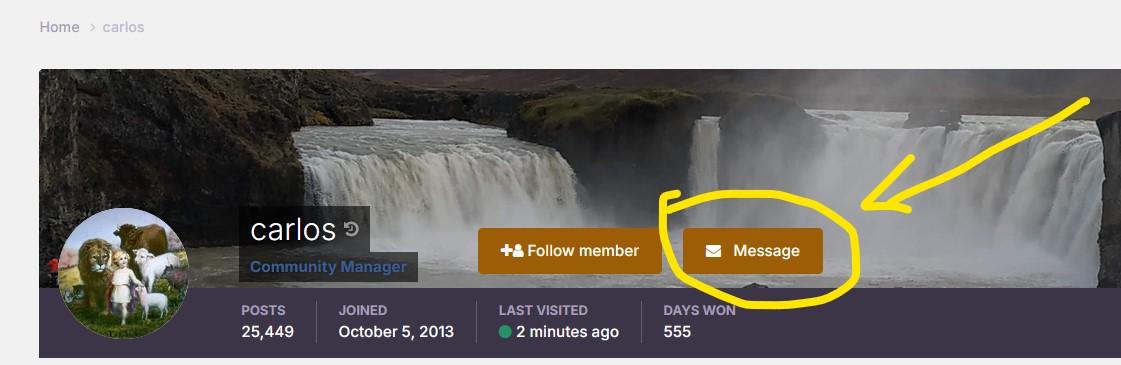
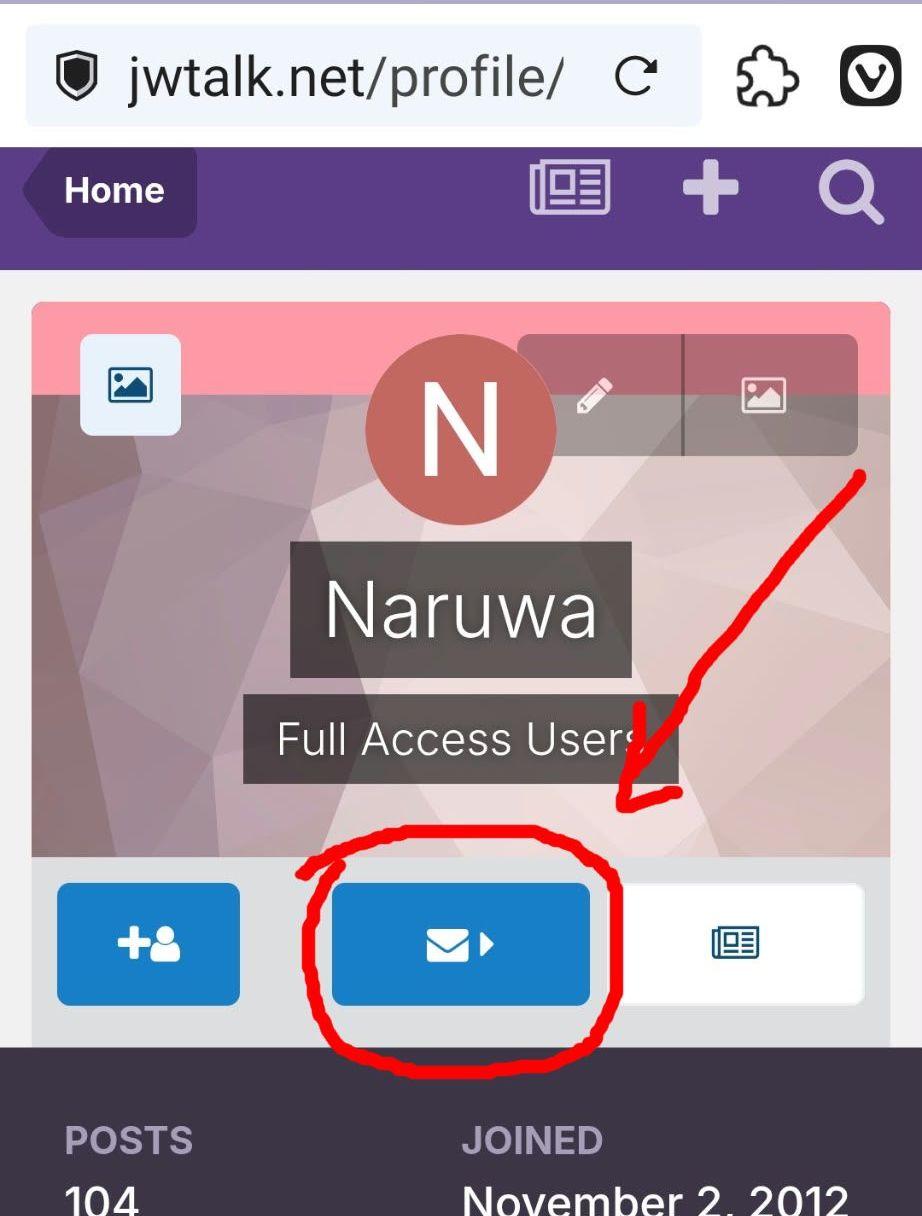
Naomi, if you are using a computer, the easiest way is to click on the name of the member you wish to message to go to their profile, then click on the Message button: If you are on a phone or tablet, it's the same but instead of that Message button there is a blue one with an envelope:
- 128 replies
-
- 2
-

-
- terms of service
- terms and conditions
- (and 3 more)
-
Investigating “Noah’s Ark”
carlos replied to Seasider's topic in Secular News in the Mainstream Media
I imagine after the flood they would use the wood to build houses or light fires, so it's very unlikely the ark is still somewhere to be found. -
I recently reported two bugs to the developers. One was that sometimes in a person's midweek meeting history you cannot see who was their partner. The other had to do with a grey sign that, according to support should appear when someone had a part recently but, at least in my case, never appears. They answered in a few days and said both bugs will be fixed in the next minor update. That's fine. I have the impression they have modified the support form too to be a bit less aggressive. For example, a question I found very condescending and annoying was: "Have you *honestly* carefully checked Help & Support? Which exact section of support did you check?". They removed that second question. Hopefully they are realizing we are customers, not annoyances, and they need to treat us kindly.
-
Any archeologist amongs us ? Biblical one ?
carlos replied to Igorianov's topic in Travel, Vacation, & Outdoor Activities
I don't know of any, but there are some members who are very knowledgeable in archeology. If you wish, share your question here and maybe you will receive some useful comments.- 1 reply
-
- 1
-

-
NWS Mobile- Beta Testing
carlos replied to dvdgarofalo's topic in Computers, Tablets, Mobile Devices, & Apps
We had a few issues at first when it was released. But since it was updated we have used it for months on Android without any problem. -
I can only speak of the situation in Spain, don't know if it's similar in the US. I sell second-hand books and other small articles from time to time. When it's only one book (300g, less than 1 lb) I send it as ordinary mail through the national mail company, the equivalent to the USPS, and it costs me 3,70€. But when I send two or more books, it's often cheaper to use a website that compares offers from several courier companies. Most of the time I can find cheaper prices than the standard pack you pay at the mail office. I see some similar websites in the US are https://www.pirateship.com/ and https://www.parcelmonkey.com/. Naturally I have never used those but it wouldn't hurt to have a look.
-
I'm only guessing here. The instructions are that inactive ones must be assigned to a group so that they are taken care of, but they should not appear in the group listing at the announcement board. So could it be that elders still see the inactive ones but publishers do not? Although I don't think publishers see the Publishers' section at all.
-
men with rings
carlos replied to grain of mustard's topic in General Discussion & Everyday Chit Chat
Raul, is it uncommon for men to wear wedding rings where you live? I thought those were standard in all the Western world. -
men with rings
carlos replied to grain of mustard's topic in General Discussion & Everyday Chit Chat
(Luke 15:22) . . .But the father said to his slaves, ‘Quick! bring out a robe, the best one, and clothe him with it, and put a ring on his hand and sandals on his feet. (James 2:2, 3) . . .For if a man with gold rings on his fingers and in splendid clothing comes into your meeting, but a poor man in filthy clothing also enters, 3 do you look with favor on the one wearing the splendid clothing and say, “You take this seat here in a fine place,” and do you say to the poor one, “You keep standing” or, “Take that seat there under my footstool”? So in principle there is nothing wrong in men wearing rings. Now of course it depends of how that is viewed in your culture. There is nothing inherently wrong in a man wearing an earring either, but in my culture that would be frowned upon. A ring is just an ornament. I we wear one, do we do it to attract attention, or just to look nice? Since we cannot judge the reasons why others do things, we can just ask those questions to ourselves. -
Hey Pete, welcome to JWTalk! Instructions vary from country to country. In Europe we cannot record anything at all, not even the contact data if we meet an interested person. We give them our contact information and pray that they call us, or try to memorize the address. In the US, on the other hand, privacy laws are a lot more permissive. In any case, I think the NW Schedule territory system could still be adapted to most situations. Instead or recording not at homes, we could use two states: done or pending. Houses that are already worked can be marked as done until the territory is finished. In case laws do not even allow that, maps can be used without marking individual houses.
-
I agree. If price needs to be adjusted, I can understand that. But a software you pay for cannot have a support like that. There are programs I have bought for $25 or $50, one single payment, not a subscription, and when I ask a question I receive a kind answer. I am not required to read the whole working manual and write a composition about it before asking. If many users ask the same questions, that means the interface is not clear enough. Fix the issues and the number of support tickets will greatly decrease.
-
I have contacted them several times for issues, suggestions and questions and my experience in general reflects yours. The support system comes across as patronizing and is definitely designed to make you feel that you are bothering them. It's commercial software that you pay for, but they try to present it as if it were freeware. Sometimes they give snarky answers to try and make you feel stupid for wasting their time. Honestly, our congregation uses NWS because we are not aware of any current alternative that does everything it does, but if there were another with friendlier support I think we would switch without hesitation. On the other hand, whenever I have contacted them they replied within one or two days, or directly solved the issue with an update in the same term, which is good.
-
Not the Spanish mainland was involved, but a Spanish city named Ceuta which is located in Africa next to Morocco. All those thousands just swam a few hundred meters around the fence into Ceuta. Everyday there are people who cross the border illegally by land and are returned to Morocco immediately. However, a recent ruling by the Spanish Supreme Court held that people who arrive by swimming cannot be returned immediately because there is no clearly defined demarcation of the border at sea. The Moroccan authorities took advantage of this ruling and encouraged many young people to swim to Spain. Around 60,000 people flooded a city with a population of about 80,000, placing enormous strain on its infrastructure. Most eventually returned after realizing they had been misled and that they would not be welcomed with open arms. Most analysts believe Morocco was testing Spain's response with a view to the future.












About carlos

Recent Profile Visitors







About JWTalk.net - Jehovah's Witnesses Online Community
Since 2006, JWTalk has proved to be a well-moderated online community for real Jehovah's Witnesses on the web. However, our community is not an official website of Jehovah's Witnesses. It is not endorsed, sponsored, or maintained by any legal entity used by Jehovah's Witnesses. We are a pro-JW community maintained by brothers and sisters around the world. We expect all community members to be active publishers in their congregations, therefore, please do not apply for membership if you are not currently one of Jehovah's Witnesses.